


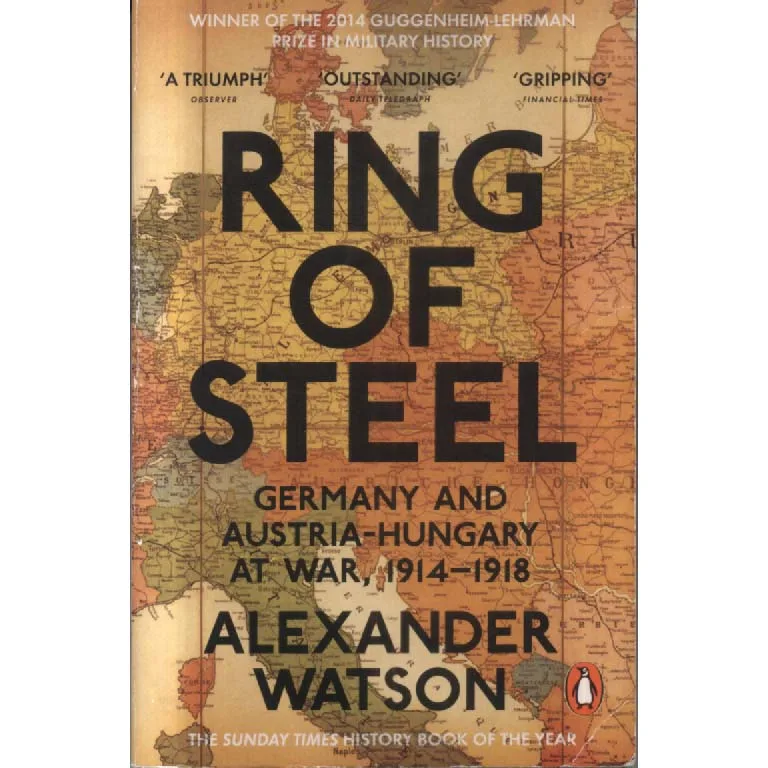
Ring Of Steel
Publisher: Penguin
Format: Paperback
ISBN: 9780141042039
Ring of Steel: Germany and Austria-Hungary at War, 1914–1918 (2015) – Alexander Watson
Penguin | ISBN: 9780141042039
Condition: As New | Sold by Crappy Old Books
The First World War. That magnificent demonstration of humanity’s ability to combine modern technology, ancient political grievances and spectacularly poor judgement into a catastrophe of almost unimaginable proportions. Millions of men were mobilised, entire economies were reorganised, and Europe’s crowned heads discovered that declaring war was considerably easier than bringing one to a satisfactory conclusion.
In Ring of Steel, historian Alexander Watson examines the Great War from a perspective often overshadowed by familiar accounts of British trenches, French battlefields and generals enthusiastically sending infantry towards machine guns. His subjects are Germany and Austria-Hungary, the two Central Powers whose struggle for survival became an increasingly desperate confrontation with enemies, economic collapse and their own internal contradictions.
Watson begins with the extraordinary events of 1914, when Europe’s political leaders stumbled into a conflict that many expected to conclude quickly. Unfortunately, nobody had adequately considered what would happen if everyone proved equally determined not to lose.
Germany and Austria-Hungary found themselves surrounded by hostile powers, fighting on multiple fronts while attempting to maintain the loyalty, productivity and morale of increasingly exhausted populations. The resulting struggle extended far beyond the battlefield, transforming everyday existence through food shortages, inflation, political repression, propaganda and the growing intrusion of the state into practically every aspect of civilian life.
One of the book’s great strengths is its attention to ordinary people. Soldiers, workers, women, families and civilians endured the consequences of decisions made by rulers and military commanders who frequently seemed to regard human suffering as an unfortunate but necessary accounting entry.
Austria-Hungary presents a particularly fascinating case. An enormous multinational empire attempting to hold together Germans, Hungarians, Czechs, Poles, Croats and numerous other communities, it faced the considerable difficulty of maintaining unity while conducting an increasingly disastrous war. Keeping such an arrangement functioning during peacetime was challenging enough. Doing so while the population was hungry and the army was losing was rather less promising.
Watson also examines the radicalisation of wartime politics, the treatment of civilian populations, the consequences of military occupation and the increasingly desperate measures adopted by governments confronting the possibility of defeat.
Drawing upon extensive historical research, he challenges simplistic explanations of the Central Powers’ experience, demonstrating how patriotic enthusiasm, fear, endurance and disillusionment shaped societies pushed towards breaking point.
Originally published in 2014, this 2015 Penguin edition is an outstanding contribution to modern military and European history, illuminating the social and political dimensions of a conflict whose consequences helped shape the catastrophes that followed.
This As New copy, offered by Crappy Old Books, is ideal for serious students of the First World War, historians of Germany and Austria-Hungary, and anyone interested in understanding how powerful states can exhaust themselves fighting wars they can no longer afford to win.
A substantial, compelling and deeply sobering account of four years of destruction, sacrifice and political disintegration.
And a reminder that when governments promise a short, glorious war, the sensible response is probably to ask whether they’ve considered the possibility that the other side has made exactly the same promise.
Keep browsing: See more History books Other books by Alexander Watson
